Terraforming
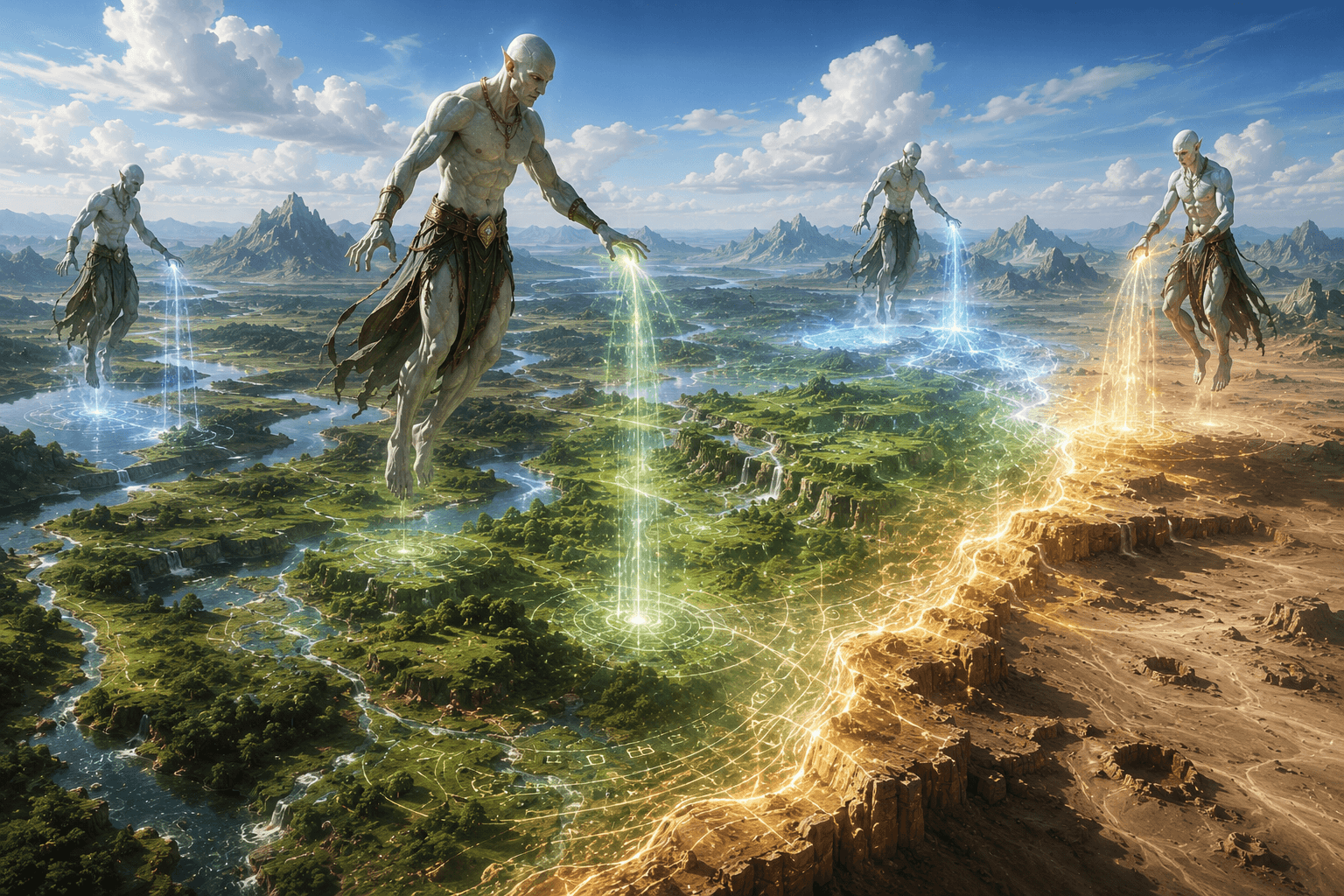
Terraforming was the process of transforming a barren or hostile world into one capable of sustaining a permanent, self-sustaining biosphere. While the Wardens possessed extraordinary dominion over the natural world, they could not create matter or alter the fundamental laws of physics. Their mastery lay in chemistry, geology, atmosphere, and ecology, reshaping existing materials into thriving worlds.
Terraforming was therefore an act of stewardship, not creation.
Planetary Selection
Not every discovered world was worth terraforming.
Before any colony was established, a survey expedition was dispatched to assess the planet's long-term potential. These expeditions consisted of a small crew of specialists accompanied by a Warden.
The survey documented the planet's geology, atmosphere, climate, orbit, water, mineral wealth, and overall suitability. Their purpose was not simply to determine whether the planet could be terraformed, but whether the years of labor required to do so were justified. Most worlds were selected for one of three reasons.
Population Worlds were most often planets whose position within the stellar habitable zone allowed them to become major population centers capable of supporting large civilizations once terraformed.
Resource Worlds contained mineral deposits valuable enough to justify generations of extraction. Although Wardens greatly improved mining efficiency by locating and exposing ore deposits, they could not create the precious elements or completely harvest them themselves. These worlds often became industrial colonies where terraforming focused on creating only the ecosystems necessary to support the population and infrastructure required for long-term mining operations.
Strategic Worlds occupied locations of military, scientific, or logistical importance. These received only the degree of terraforming necessary to sustain small settlements and fulfill their intended purpose.
Planetary Inventory
Every survey established a planetary inventory.
Most rocky worlds naturally contained the common elements necessary for life, including oxygen, hydrogen, carbon, nitrogen, silicon, iron, sulfur, phosphorus, and other trace elements. While these materials frequently existed in inaccessible forms, bound within minerals, frozen beneath the surface, or dispersed throughout the crust, Wardens rearranged these existing materials into useful chemical forms.
Inventory Acquisition
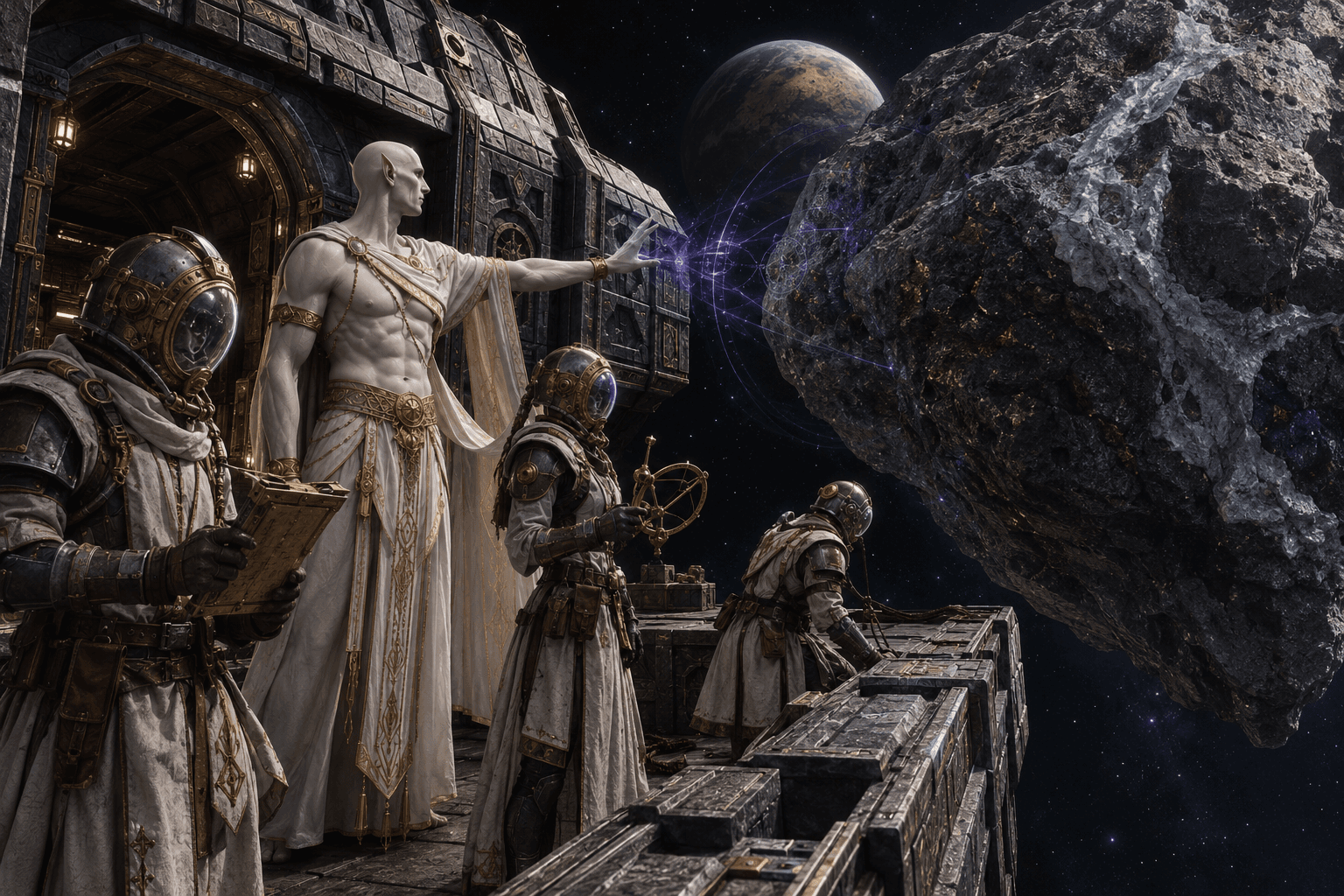
Many otherwise suitable planets possessed insufficient materials required to establish stable oceans and atmospheres.
Specialized asteroid acquisition crews, aboard star arks, recovered these materials directly from within the system. These crews located suitable asteroids, and a Warden redirected them onto carefully calculated impact trajectories with the destination world.
The asteroid itself became the cargo.
These controlled impacts delivered enormous quantities of water, carbon, nitrogen, and other essential compounds needed to complete the planet's chemical inventory. Once delivered, Warden terraforming teams redistributed and incorporated these materials into the developing world.
Stages of Terraforming
Terraforming was performed by teams of Wardens, each contributing their mastery toward a coordinated planetary transformation.
Terraforming generally progressed through four broad stages.
- Preparation established stable geology, atmosphere, oceans, and long-term climate.
- Chemical converted existing materials into the chemical forms necessary for life while incorporating any imported resources.
- Seeding introduced carefully designed microbial and biological communities transplanted from Riftmoor, establishing soils, nutrient cycles, and the foundations of a functioning biosphere.
- Succession allowed forests, grasslands, wetlands, reefs, and animal life to mature into stable ecosystems capable of sustaining themselves for generations without continual Warden oversight.
Warden terraforming relied upon chemistry rather than particle physics. They could not create new matter, change elements, or alter planetary orbits. They reshaped. Every terraformed world therefore remained fundamentally influenced by its solar system.
Stellar Zones
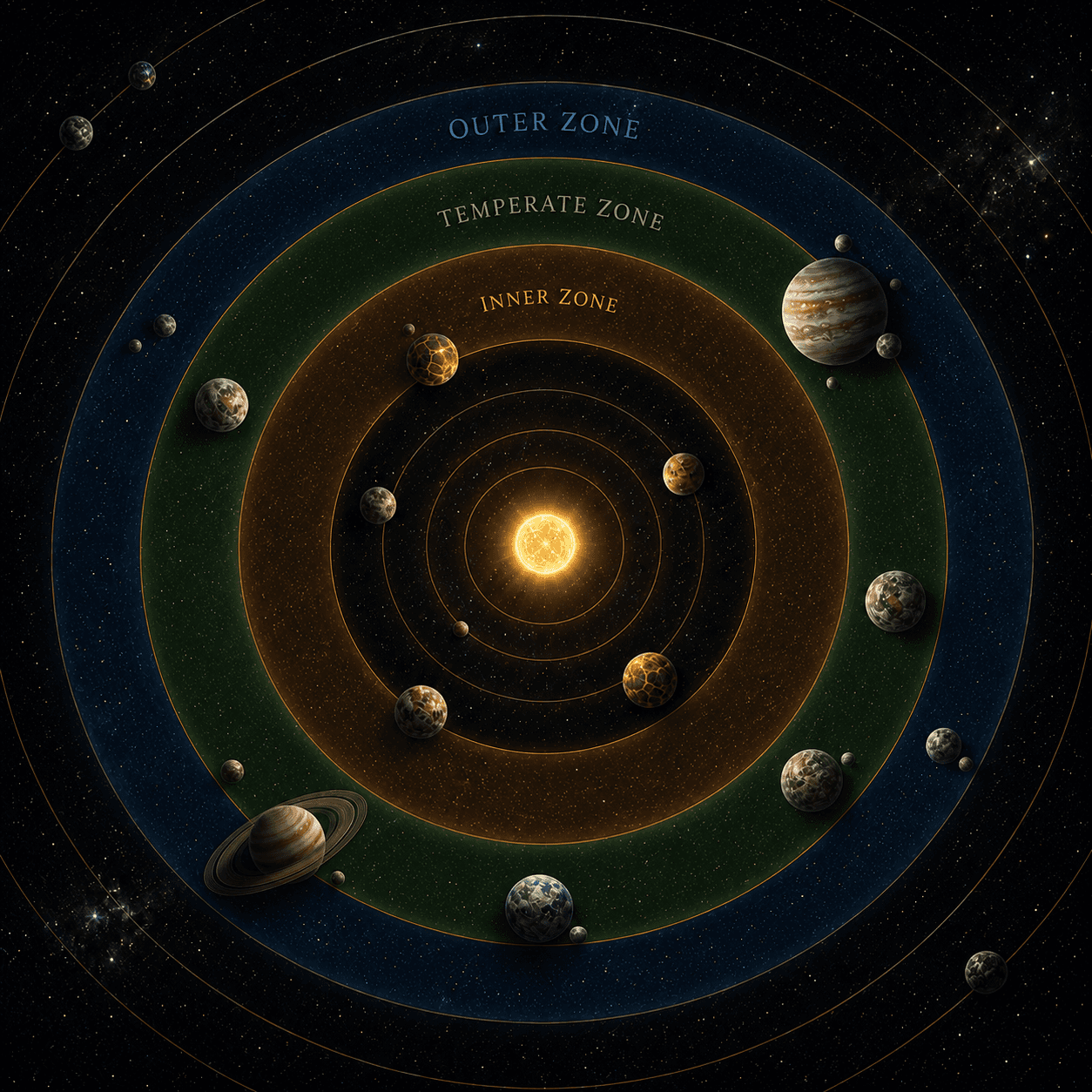
Every star system possessed three terraforming zones determined by the energy received from its star. Planets lying closer to or farther from the star than these zones encompassed were considered unfit for terraforming.
The Temperate Zone naturally received conditions most favorable to temperate climates and required the least intervention to become a thriving world.
The Inner Zone consisted of hotter worlds receiving greater stellar energy. These planets could still be terraformed into prosperous civilizations, though they naturally retained warmer climates, stronger sunlight, and greater evaporation.
The Outer Zone contained colder worlds where weaker sunlight produced longer winters, cooler climates, and slower biological growth despite successful terraforming.
The Reach
The Reach was the solar system of Riftmoor and contained the Rift Scar.
Within the Reach, reality itself proved more resistant to reshaping. Wardens reliably transformed suitable rocky worlds into habitable planets, but they could not optimize them according to their stellar zones as they could elsewhere.
Worlds within the Habitable Zone slowly became fertile population centers similar to Riftmoor itself.
Inner worlds remained intensely hot, while outer worlds retained extremely cold climates. They were made livable and sustained permanent atmospheres and ecosystems, but the intensity of their natural zones could not be reduced further.
Terraforming within the Reach emphasized adaptation rather than perfection. Every world preserved a strong natural identity, and its inhabitants grew hardier rather than their climates becoming gentler.
Beyond the Reach
As distance from Riftmoor increased, the influence of the Rift Scar diminished. Reality became increasingly receptive to reshaping, allowing climates, atmospheres, and ecosystems to be refined much further.
The stellar zones themselves never disappeared. Hot planets remained hot relative to their systems, while outer planets remained cooler than those nearer their star.
The degree to which Wardens refined those conditions only increased.
Some warm inner worlds were moderated into tropical climates rather than harsh deserts. Some cold outer worlds became taiga climates instead of frozen frontiers.
The farther civilization expanded from Riftmoor, the wider the range of planets that could be transformed into flourishing homes. Terraforming that required generations within the Reach sometimes demanded only decades in neighboring systems, while the most distant colonies were transformed after only a few years of sustained Warden labor.
The Reach of the Rift
As time went on, the Wardens discovered that the farther something was from the Scar above Riftmoor, the easier it was for them to reshape it through magic.
Riftmoor itself resisted almost all attempts at magical alteration. Its mountains, rivers, forests, and seas cannot simply be rewritten, their writing had been completed. Though immensely powerful, the Wardens turned to the labor of the heirs to build roads, cities, walls, canals, and kingdoms. The world could be forcibly reshaped only by pick and shovel, yet it remained largely as it had always been.
The moons and planets of Riftmoor's own system are only slightly less resistant. Terraforming them was possible, but required centuries of continuous effort by many Wardens. They remained within the reach of the scar, for this reason, the system of Riftmoor was synonymously known as “The Reach.”
Worlds in neighboring star systems proved easier to shape. Entire planets could be transformed and shaped to a warden’s specific vision within a century, making them attractive targets for colonization.
At the farthest reaches of the galaxy, reality offered almost no resistance. Skilled Wardens could together reshape an entire world within only a few years.
Yet these distant worlds were of limited value.
The Throne remained on Riftmoor.
Every colony, fortress, and new world existed for the same purpose: to strengthen its Warden's claim to the Throne. The farther one traveled from Riftmoor, the easier it became to wield power—but the farther one stood from the only place where that power truly matters.
For this reason, expansion always followed a chain. The Wardens first spread across the remaining continents of Riftmoor, then throughout its star system, then to the neighboring systems, but eventually to the distant reaches of the galaxy. Every new colony became another step on the long road back to Providence.
