The Galaxy

Galactic Structure and Habitability
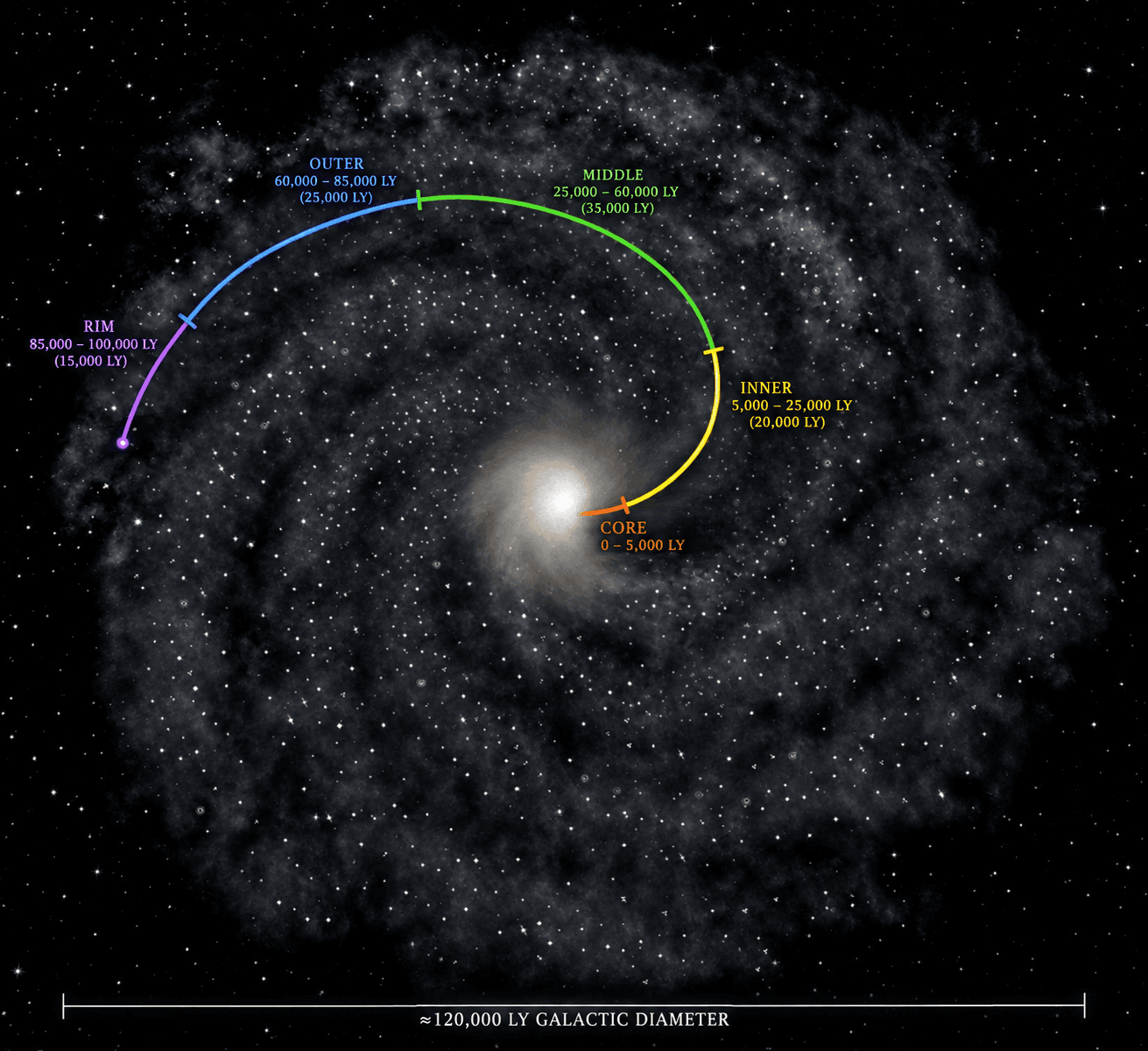
The known galaxy is a roughly 120,000-light-year-wide, six-armed spiral containing approximately one million star systems. Each arm follows a curved central path, or arm bone, approximately 100,000 light-years long. The galaxy's 120,000-light-year diameter measures straight across the galactic disk, while arm length follows the curved path of an arm as it sweeps roughly halfway around the galaxy.
For mapping, each arm is divided by bone distance into five broad zones: Core (0–5,000 ly), Inner (5,000–25,000 ly), Middle (25,000–60,000 ly), Outer (60,000–85,000 ly), and Rim (85,000–100,000 ly). These divisions describe broad statistical environments rather than rigid boundaries.
Stars and heavy elements are concentrated Coreward, along with greater radiation, stellar crowding, gravitational disturbance, and other hazards. Moving Rimward reduces these dangers but also decreases stellar density and resource abundance. The Middle Zone provides the most favorable balance and is the galaxy's primary terraforming and settlement sweet spot. Approximately 5% of Middle systems are usable, compared with roughly 1–2% elsewhere, for about 24,000 usable systems among the galaxy's one million.
A usable system is not necessarily habitable when discovered; it contains at least one world with sufficient fundamental conditions for large-scale terraforming. Only a small fraction were ever developed by the Wardens, leaving most of the galaxy an undeveloped frontier.
Galactic Structure and Zone Model
The six spiral arms concentrate stars into distinct corridors without containing all galactic stars. Arm Area Factor estimates how much of each zone is occupied by the arms, while Stars Within Arms describes how strongly that zone's systems are concentrated within them. Together these determine Arm Stellar Density, the most useful density measure for travel within the arms.
Bone distance is distinct from straight-line distance to the galactic center. It measures progress along the curved arm and determines whether a location is considered Core, Inner, Middle, Outer, or Rim. Consequently, a system 50,000 light-years along its arm bone is not necessarily 50,000 light-years from the galactic center.
Within the arms, characteristic system spacing increases from approximately 28 ly in the Core to about 100 ly in the Middle and 147 ly in the Rim. Usable systems are considerably farther apart, averaging roughly 470–500 ly in the Middle Zone.
Stellar density also affects warp navigation. A warp corridor must remain approximately one light-year clear of intervening stellar gravity wells, making long unobstructed routes much rarer Coreward and increasingly common toward the Rim. The chart's clear-warp figures therefore represent the probability of finding an unobstructed corridor rather than maximum warp distance. Warp stability imposes a separate long-distance limitation, particularly in sparse regions where clear corridors can greatly exceed the distance at which a jump remains precise.
Together, these values provide the statistical framework for exploration, settlement, terraforming, warp travel, resources, and galactic geography. Individual systems can depart substantially from their regional averages, allowing exceptional worlds, unusually clear warp corridors, resource-rich frontier systems, and dangerous anomalies without undermining the larger structure of the galaxy.
| Metric | Core | Inner | Middle | Outer | Rim | Galactic |
|---|---|---|---|---|---|---|
| Arm-Bone Distance from Center (ly) | 0-5,000 | 5,000-25,000 | 25,000-60,000 | 60,000-85,000 | 85,000-100,000 | — |
| Bone Outer Radius (ly) | 5,000 | 25,000 | 60,000 | 85,000 | 100,000 | — |
| Region Length (ly) | 5,000 | 20,000 | 35,000 | 25,000 | 15,000 | |
| Area (million ly²) | 78.5 | 628 | 3,140 | 4,003.50 | 3,454 | 11,304 |
| Galactic Area | 0.70% | 5.60% | 27.80% | 35.40% | 30.60% | 100% |
| Star Systems | 100,000 | 450,000 | 200,000 | 150,000 | 100,000 | 1,000,000 |
| Galactic Stars | 10% | 45% | 20% | 15% | 10% | 100% |
| Relative Stellar Density | 14.4 | 8.1 | 0.72 | 0.42 | 0.33 | 1 |
| Galactic AVG Stellar Density | Very High | High | Moderate | Low | Very Low | — |
| Arm Area Factor (% of zone’s area occupied by arms) | 100% | 80% | 60% | 35% | 25% | |
| Stars Within Arms | 100% | 95% | 85% | 70% | 40% | |
| Arm Stellar Density (warp factor) | 14.40 | 9.62 | 1.02 | 0.84 | 0.53 | |
| Arm Area | 78500000 | 502400000 | 1884000000 | 1401225000 | 863500000 | |
| Avg distance between stars | 28 | 34 | 105 | 116 | 147 | |
| Avg distance between usable stars | 280 | 242 | 471 | 817 | 1469 | |
| Resource / Metal Abundance | Very High | High | Moderate | Low | Very Low | — |
| Environmental Hazards | Very High | High | Moderate | Low | Very Low | — |
| Usable Systems | 1,000 | 9,000 | 10,000 | 3,000 | 1,000 | 24,000 |
| Usable Systems (better likelihood per system and better quality prospects) | 1% | 2% | 5% | 2% | 1% | 2.40% |
| Estimated Clear Warp Range — 50% chance (ly) | 272 | 408 | 3,841 | 4,625 | 7,482 | |
| Clear-Path Variance — 90% to 10% chance (ly) | 41–903 | 62–1,354 | 584–12,759 | 703–15,363 | 1,137–24,854 | |
| Terraforming Prospects | Low | Moderate | High | Moderate | Low | — |
| Character | Extreme risk / extreme reward | High risk / high reward | Settlement sweet spot | Low risk / lower reward | Deep frontier | — |
Stellar Density, Warp Navigation, and Warden Expansion
Arm Stellar Density measures how tightly star systems are concentrated within the galaxy's spiral arms rather than averaging them across the largely empty inter-arm regions. Density falls substantially outward: characteristic spacing between stars increases from roughly 28 ly in the Core, to 105 ly in the Middle, and 147 ly in the Rim. Usable systems are considerably rarer; within the settlement-friendly Middle Zone, potentially terraformable systems are characteristically about 470 ly apart.
Warp travel works by compressing and displacing spacetime between the traveler and destination. The Wardens accomplished this directly through their own power, while Fourth Age warp drives reproduce the same effect through sophisticated Riftech enchantments powered by Rift cells. Longer warps require greater power and Rift-cell expenditure, but there is no fundamental maximum warp distance. In practice, a stable warp corridor must follow a straight path and cannot pass within approximately one light-year of another stellar gravity well.
Arm Stellar Density therefore determines the probability of finding a sufficiently long clear warp corridor, rather than imposing a fixed range. In the Middle Zone, the mean unobstructed corridor is roughly 5,500 ly; a 500-ly route has about a 91% chance of being clear, while a 1,000-ly route has about an 83% chance. In the dense Core, the mean clear corridor falls to roughly 400 ly, reducing those probabilities to approximately 28% and 8% respectively. Conversely, the sparse Outer and Rim regions permit increasingly long uninterrupted warps. Exceptional alignments can always allow much longer jumps; increasing stellar density simply makes such paths progressively less likely.
Clearance does not guarantee precision. Warp stability decreases with distance, causing increasing uncertainty in the point of arrival even when the intended destination is successfully reached. During the Second Age, jumps of roughly 1,500 ly or less were sufficiently precise to choose an arrival region and preserve useful fleet cohesion. Around 2,000 ly, a vessel could still reliably reach the intended stellar system, but its precise arrival point became uncertain enough to make coordinated military jumps increasingly dangerous. Much longer jumps remained practical for individual travel, particularly toward the sparse Rim, but eventually risked missing the intended system altogether.
These conditions strongly shaped Warden expansion during the Second Age. The Middle Zone offered the best combination of terraformable worlds, manageable hazards, abundant resources, and navigable warp corridors. The Wardens expanded selectively from Riftmoor through its portion of one of the galaxy's six spiral arms, choosing systems not only for their worlds and resources but also for their strategic positions within reliable warp networks. Many otherwise usable systems were deliberately bypassed.
At their height, approximately 150 systems had been terraformed and permanently inhabited across the roughly 50-million-square-light-year Span, with thirty developing into major population centers. The Reach lay near its contested center, with the Alliance expanding primarily Rimward and the Empire primarily Coreward. Both powers spread farther Spinward and Trailward behind their respective fronts, producing the Span's characteristic bent hourglass shape: narrow around the contested Reach, widening into more secure territories in either direction, and curving with the Riftmoor Arm.
Warden Expansion and the Fourth Age
During the Second Age, the Wardens' roughly 150 settled systems represented only a small portion of the suitable worlds even within their own region of the Riftmoor Arm. After the Vanishing, these isolated worlds became the foundations of Third Age civilizations. By the Fourth Age, interstellar travel has reconnected the old Warden worlds, while improved Riftech has substantially increased warp precision. The finest Fourth Age drives can stabilize stellar-anchored jumps approaching 5,000 ly, allowing travel and coordinated expansion across distances that would have been dangerously imprecise during the Second Age.
Mortal terraforming remains vastly slower and more difficult; ancient Warden worlds therefore remain the principal population centers while stations, habitats, mines, military bases, and frontier settlements spread beyond them. With roughly 24,000 potentially terraformable systems among one million stars, numerous suitable systems left untouched even within the Span, and five entire galactic arms essentially untouched by Warden settlement, most of the galaxy remains an enormous open frontier.
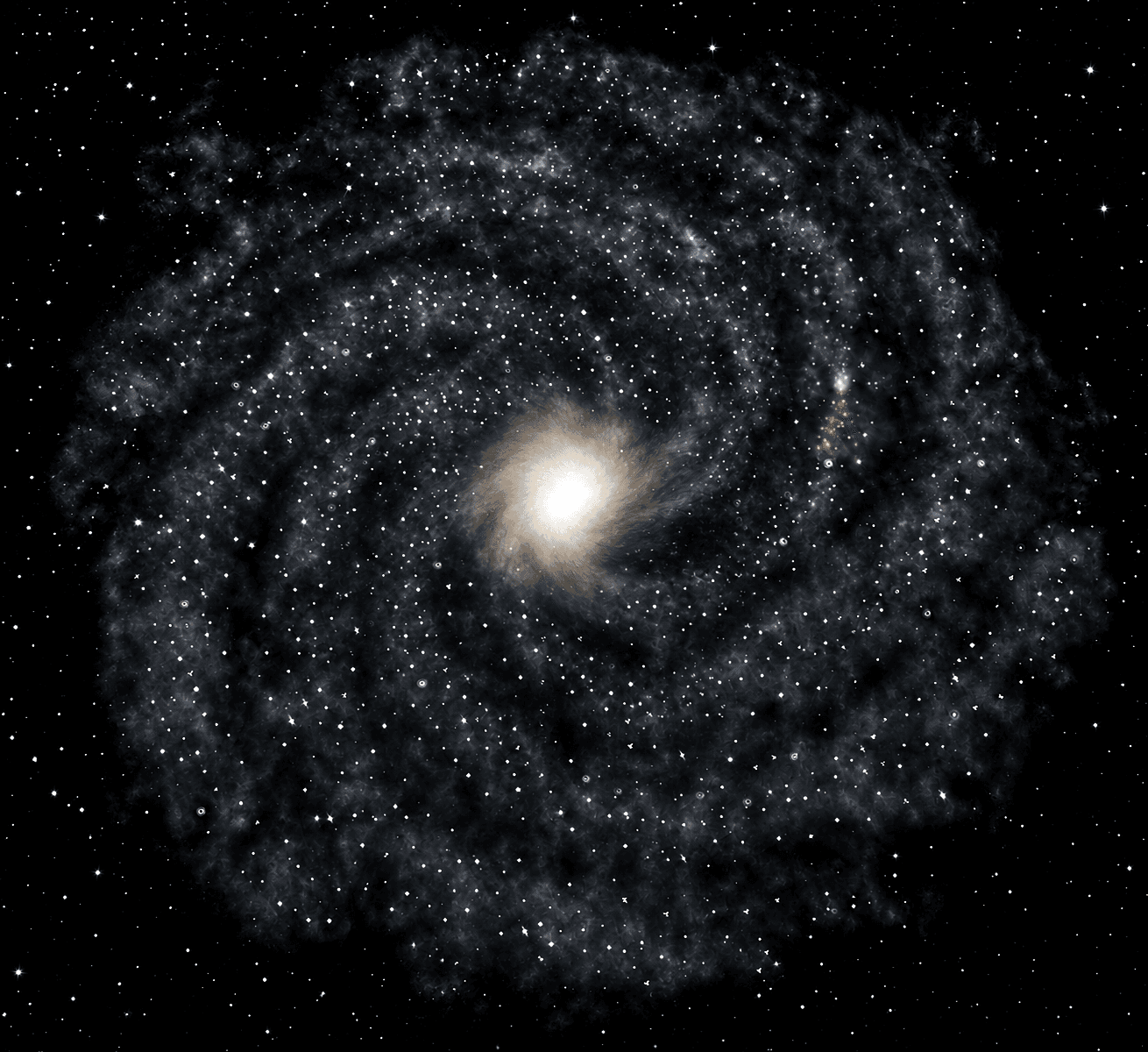
| The six-armed Galaxy, showing its the five arm regions with a single highlighted arm bone tracing the Core, Inner, Middle, Outer, and Rim. | The Galaxy with The Span highlighted within one arm, showing the small extent of Warden-settled space by the end of the Second Age. |
|---|---|
 |  |
The Centrality of Riftmoor
Throughout the Second Age, Warden civilization expanded without ever truly moving its political center away from Riftmoor. To the Wardens, distant colonies, prosperous homeworlds, and eventually entire interstellar territories were extensions of the same ancient struggle for the Reach, Riftmoor, the Vale, Providence, and ultimately the Throne. The Empire continued ruling from contested Providence even as safer and more prosperous Imperial worlds developed elsewhere, while the Alliance treated its own great capitals as temporary seats awaiting the eventual conquest of the rightful capital on Riftmoor. Mortal Heirs increasingly regarded these arrangements as impractical, viewing their secure and populous homeworlds as the natural centers of interstellar civilization. After the Vanishing, this mortal conception gradually prevailed. The ancient conflict could finally end, borders could stabilize, and Riftmoor itself eventually developed a more unified culture. By the Fourth Age, the centers of political power had shifted to the great worlds of the wider galaxy. Riftmoor remained uniquely important as the ancestral world of mortal civilization, a place of immense historical significance, and the galaxy's greatest source of Rift energy and crystals—but no longer as the natural capital of interstellar civilization.
Mapping
Interstellar Mapping Conventions
Interstellar civilizations use several overlapping mapping conventions. No single system is ideal at every scale: astronomers favor absolute galactic measurements, while navigators and ordinary travelers generally use coordinates based on the spiral arms themselves. All conventions use the standardized Headside view of the galaxy, from which galactic rotation appears clockwise. Positions above the galactic plane are positive, toward Headside, while positions below it are negative, toward Tailside.
Arm-Bone Coordinates
The most common and intuitive interstellar mapping convention follows the galaxy's spiral arms. Each arm is assigned an imaginary central path, or arm bone, running along the center of its stellar distribution. Position is measured relative to this path rather than by straight-line distance from the galactic center.
Four principal directions are used:
-
Coreward (C): down the arm toward its coreward end.
-
Rimward (R): up the arm toward its rimward end.
-
Spinward (S): perpendicular to the arm bone in the direction of galactic rotation.
-
Trailward (T): perpendicular to the arm bone opposite galactic rotation.
Intermediate directions combine these terms: RS, CS, CT, and RT.
A complete arm coordinate consists of four values: arm number, distance along the arm bone from its coreward origin, lateral displacement from the bone, and plane offset. Spinward displacement is positive and Trailward displacement negative. Plane displacement is positive toward Headside and negative toward Tailside.
For example:
1 / 40,000 / −234 / +250
indicates Arm 1, 40,000 light-years along its bone from the coreward origin, 234 light-years Trailward of the bone, and 250 light-years Headside of the galactic plane.
Because all directional information can be expressed through positive and negative values, precise coordinates can be written entirely numerically.
This convention also defines the galaxy's broad Core, Inner, Middle, Outer, and Rim Zones. These zones follow distance along the arm bones rather than forming simple concentric circles around the galactic center. Their boundaries consequently follow the general flow and curvature of the spiral arms.
Galactocentric Coordinates
A second, more mathematically absolute convention ignores the spiral-arm structure and measures every system directly relative to the galactic center.
A position is described primarily by its angular bearing in degrees and its straight-line distance from the galactic center, with plane offset supplying the third dimension.
Unlike arm-bone coordinates, this system describes a star's geometric position without reference to the shape of its spiral arm. It is consequently useful for astronomy, computation, and precise galaxy-wide comparisons.
Its weakness is practical navigation. Spiral arms curve substantially, so two locations with straightforward galactocentric coordinates may occupy very different positions relative to the actual stellar corridors through which civilization travels. Traveling “toward the core” geometrically is not necessarily the same as traveling Coreward down an arm.
For this reason, galactocentric coordinates are extremely precise but generally less intuitive than arm-bone coordinates.
Plane Offset
Both systems retain the galaxy's third dimension through a simple plane offset, measured in light-years from the galaxy's averaged central plane.
Positive (+) values are automatically understood as Headside.
Negative (−) values are automatically understood as Tailside.
0 lies on the averaged galactic plane.
The Headside/Tailside distinction is therefore normally omitted from formal coordinates. A plane coordinate of +250 means 250 light-years Headside, while −250 means 250 light-years Tailside.
The vertical coordinate is essential for precise navigation but is commonly omitted from political maps, where the galaxy is represented approximately two-dimensionally.
Local and Political Mapping
Smaller regions may establish additional coordinate conventions around historically important systems. Within the Span, for example, the Reach provides a natural cultural and navigational reference point. Distances and bearings can therefore be expressed relative to the Reach when this is more useful than providing a full galactic address.
These local systems do not replace arm-bone or galactocentric coordinates. They function much as regional maps coexist with global coordinates: the simplest convention appropriate to the scale generally wins.
Thus the same star may possess several equally valid descriptions. Galactocentric coordinates describe exactly where it is; arm-bone coordinates describe where it lies within the structure of the galaxy; local coordinates describe where it lies relative to the places civilization actually cares about.
Warp Stability and the Expansion of the Span
During the Second Age, warp travel was limited not only by intervening gravity wells, but by increasing instability over long distances. Stellar gravity wells provided strong spacetime anchors for navigation and arrival, allowing short and moderate jumps to terminate with considerable precision. At roughly 1,500 light-years or less, experienced Wardens could generally choose their arrival region accurately enough for fleets to remain organized. Beyond this distance, positional uncertainty increased rapidly. Jumps of 2,000 light-years or more remained practical for individual travel, but could scatter a fleet across a significant portion of a stellar system, making such jumps dangerous in warfare. At still greater distances, even arrival within the intended system became uncertain.
This limitation strongly shaped the Span, which covered roughly 50 million square light-years of the Riftmoor Arm's Middle Zone. Warden powers did not simply terraform every suitable system they discovered. Worlds were selected partly according to their position within reliable warp networks: major settlements and defensive bastions were placed within dependable reinforcement distance of friendly systems while avoiding unnecessary proximity to enemy strongholds. Many otherwise usable systems were deliberately bypassed because their location offered poor strategic depth or unfavorable warp access.
With the Reach near its contested center, the Alliance expanded Rimward, while the Empire expanded Coreward. Each side established heavily defended forward systems near the Reach, followed by increasingly secure settlements farther into its own territory. Because settlement could spread more freely once safely distanced from the opposing frontier, the Span developed an unusual bent hourglass shape, narrow around the contested Reach and broadening toward the distant Alliance and Imperial regions while following the curvature of the Riftmoor Arm. Its geography therefore reflected military strategy and warp range as much as the distribution of terraformable worlds.
By the Fourth Age, improved Riftech drives, navigation, and stabilization systems substantially expanded the precision envelope. The finest warp drives could maintain controlled stellar-anchored jumps approaching 5,000 light-years, allowing routes and coordinated movements that would have been dangerously inaccurate during the Second Age. This technological improvement helped rapidly reconnect the isolated worlds of the former Span and diminished many of the strategic barriers that had originally shaped it. Warp distance nevertheless remained finite in practice: instability continued to increase beyond the stabilized range, while jumps into deep space were substantially less reliable without a stellar gravity well to anchor their termination. Even Fourth Age vessels therefore found the enormous empty distances between galactic arms difficult and hazardous to cross.
| Jump Distance | Typical Stellar-Anchored Exit Uncertainty | Practical Meaning |
|---|---|---|
| 500 ly | negligible / local-navigation scale | essentially exact |
| 1,000 ly | very small | chosen system arrival zone easily maintained |
| 1,500 ly | AU-scale | reliable precision jump; fleets remain organized |
| 1,750 ly | tens to hundreds of AU | formation begins spreading badly |
| 2,000 ly | ~1 ly | right system, but tactical formation is effectively destroyed |
| 2,500 ly | ~1–2 ly | system-scale arrival becomes uncertain |
| 3,000 ly | several ly | destination star still useful as an anchor, but misses become meaningful |
| 5,000 ly | many ly | landing in the intended system is no longer dependable |
| Inter-arm | hundreds/thousands of ly possible | destination solution becomes extremely unreliable |
Warp Stability and Inter-Arm Travel
Large stretches of empty space do not permit unlimited warp travel. Although the absence of intervening gravity wells creates longer clear warp corridors, stellar gravity wells also serve as stabilizing endpoints for warp. A star produces a distinct distortion in spacetime that allows a Warden or warp drive to accurately resolve both the direction and termination of a jump.
Without such an anchor, warp becomes increasingly unreliable with distance. Small errors in direction, distance, or termination can produce enormous deviations over thousands of light-years, causing a traveler to undershoot, overshoot, or emerge far from the intended course. Dead-space jumps are possible, but nearly impossible to execute reliably and increasingly dangerous when chained together. This makes the vast gaps between spiral arms poor routes despite their unobstructed space, and inter-arm travel was rarely considered worth the risk.
The same effect becomes increasingly important Rimward. Falling stellar density opens longer unobstructed corridors, but the advantage eventually produces diminishing returns: once corridors become longer than warp can reliably resolve, warp stability rather than stellar obstruction becomes the dominant limitation. In the crowded Middle Zone this stability limit is scarcely noticeable because gravity wells provide frequent endpoints and serve to limit unobstructed paths; toward the Rim and between the arms, it becomes one of the principal limits on practical warp distance.
